Pool chemicals · pH調低劑
pH decreaser (dry acid)
Sodium bisulphate granules that bring a high pH back into the 7.2–7.8 band — the fix for weak chlorine, cloudy water and scale, with safer handling than liquid acid.

Sodium bisulphate granules that bring a high pH back into the 7.2–7.8 band — the fix for weak chlorine, cloudy water and scale, with safer handling than liquid acid.
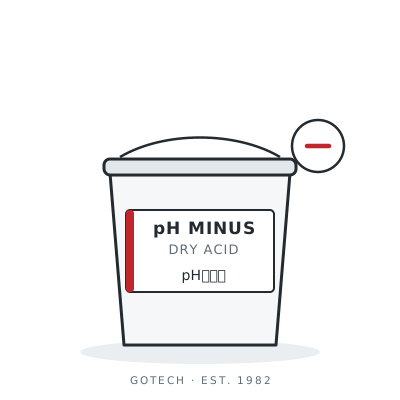
pH decreaser is dry acid — sodium bisulphate. Use it when a test shows pH above 7.8, where chlorine turns weak, water clouds and scale forms. Granules handle far more safely than liquid muriatic acid. Test first, dose in small steps, retest after circulation.
Sodium bisulphate (NaHSO₄), an acid in dry granular form — the reason it is sold as "dry acid". Dissolved into the pool it neutralises excess alkalinity and pulls a high pH back towards the working band, taking total alkalinity down somewhat as it goes. Compared with hydrochloric (muriatic) acid it does the same job without the fuming, splashing and storage headaches, which is why most residential and clubhouse pools choose it. Which corrector your pool needs usually follows from the chlorine it runs: trichlor tablets are acidic and tend to pull pH down, while sodium hypochlorite is alkaline and pushes it up — so hypochlorite-fed pools are the ones that most often reach for pH decreaser, and tablet-fed pools for the pH increaser.
| Form | Dry white granules, readily soluble |
| Chemistry | Sodium bisulphate (dry acid), NaHSO₄ — acidic pH corrector |
| Formats | Pack sizes confirmed on enquiry |
| Best for | Pools where pH tests above 7.8 — commonly pools dosing alkaline sodium hypochlorite |
| Price | Quoted on enquiry — we reply within one working day |
Test first, then dose. If pH reads above 7.8, pre-dissolve the granules in a bucket of pool water and add the solution with the pump running — spread around the pool rather than in one spot — then retest after a full circulation before adding more. Small steps matter: overshooting drops you into corrosive territory below 7.2, which is the opposite problem. The dosing calculator gives a starting point for your pool volume, and the pool water balance guide explains the bands you are holding.
If pH climbs straight back within days, look at total alkalinity: a very high buffer drags pH upward and takes repeated, measured acid additions to bring down — patience, not one big dose. Operators balancing pH, alkalinity and hardness together can read our Langelier Saturation Index explainer for the fuller picture, and periodic laboratory testing confirms what strip kits only estimate.
Safety. Dry acid is an acid: it irritates and can burn eyes and skin, so wear gloves and eye protection and avoid raising dust. Never mix it with chlorine products — acid contacting hypochlorite or tablets releases toxic chlorine gas — and never pre-mix it with any other chemical; add each chemical to the pool separately. Store cool, dry and sealed, away from chlorine and alkalis, and keep away from children. Safety data sheets are available on request: see the SDS library.
Prices and pack sizes are quoted on enquiry — we reply within one working day. Delivery across Hong Kong; ask about a standing delivery for estates and operators.
Both lower pH. Hydrochloric acid does the same job but fumes, splashes and is harder to store, measure and transport, which is why most residential and clubhouse pools choose sodium bisulphate granules instead. Whichever you use: test first, pre-dissolve dry acid in a bucket of pool water, dose in small steps with the pump running, retest after a full circulation, and never let acid contact chlorine products.
When a test shows pH above 7.8. Up there much of your chlorine sits in a weak form that barely disinfects, the water tends to cloud, and scale starts to deposit on tiles and heaters. Test first, dose in small steps with the pump running, and retest after the water has circulated before adding more.
It is easier and safer to handle: dry granules do not fume or splash the way hydrochloric (muriatic) acid does, and they are simpler to store, measure and transport. It is still an acid — wear gloves and eye protection, pre-dissolve it in water, and never let it contact chlorine products.
Often the chlorine you run: sodium hypochlorite (liquid chlorine) is alkaline and pushes pH up with every dose. Aeration from water features, high total alkalinity and fresh plaster or grout push the same way. Trichlor tablets pull pH down instead — so the corrector your pool needs depends on the chlorine it runs.
Send us your latest test readings — or the pool size and a photo of what you use now — and we'll tell you what to correct, in what order. No obligation.